
Cognitive Load Has a Floor, Not a Peak
There is a piece of LinkedIn advice that sounds like wisdom because it sounds like moderation. Keep your posts light, but not too light. Make the reader think, but never make them work. Somewhere between a nursery rhyme and a white paper, the story goes, sits an optimal density, and the job of a writer is to find it. We went looking for that sweet spot in the Authority Index. We found a floor instead, and above the floor we found nothing at all.
What we mean by load
Cognitive load is the mental effort a post asks of its reader. Every post in the Index carries a load score, computed from measurable features of the text: how long the sentences run, how complex they are, how many separate ideas compete for attention inside a single line. No human judged any of it. The score reads the same way for a post from a large account and a small one, because it never looks at the audience.
The editor splits the same idea in two. Intrinsic load is the effort the substance demands, and it rises with the density of specialised terms and with the number of concepts packed into each sentence. Extraneous load is the effort the presentation adds on top, and it rises as white space and formatting clarity fall. The distinction matters for what follows, because one of those two is worth paying and the other is pure friction.
The peak we used to report
An earlier version of the corpus report named two peaks. Average engagement crested in one load band, the share of Exceptional posts crested in another, and we drew a tidy lesson from the gap between them: density raises the ceiling rather than the average. It read well. It was also wrong, for the reason that has corrected finding after finding in this series.
Load is a habit. Some creators write dense every time and some write light every time, so when you sort posts into load bands you are largely sorting creators into piles. Any difference between the piles is then mostly a difference between the people in them, and the biggest difference between people on LinkedIn is audience size. Both peaks were that artefact wearing a lab coat.
What survives when each writer is measured against themselves
So we re-ran it the way we now run everything. The five bands stay defined across the whole corpus, lightest to densest, because load is a property of the post and a creator-relative band would answer a different question. What moved was the yardstick. Every post is now measured against its own author's average, so a band's figure is a within-creator index: 1.00 means posts in that band do exactly what their writers usually do.
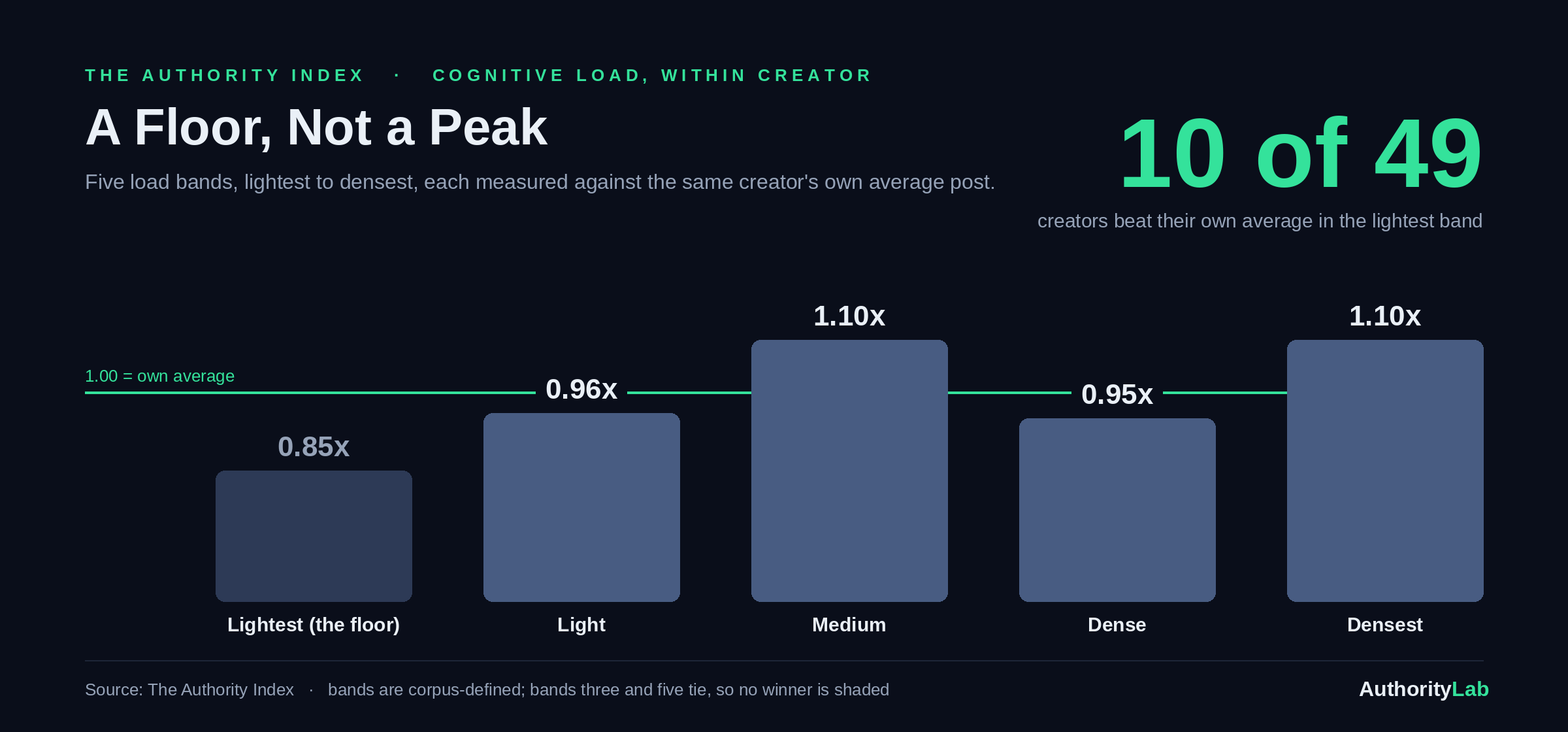
Read from lightest to densest, the five bands come out at 0.85, 0.96, 1.10, 0.95 and 1.10. The middle band and the densest band tie. The band between them dips. Nothing about that sequence describes a hill with a summit, and the moment you try to shade a winning row you are asserting an order the figures refuse to support.
The floor is real
The lightest band is the one result that holds on every measure we tried. Its index sits at 0.85, and in creator terms the picture is starker: only 10 of 49 creators beat their own average when they publish in that band. The rest do worse than their own norm the moment they strip the effort out of a post. That is what a floor looks like in data, and it is the whole finding.
The obvious next question is where the ceiling sits, and the honest answer is that the data has not found one. Bands three and five tie at 1.10. A dip of the size sitting between them is not something any careful reader should build advice on. We can tell you the lightest band costs you. We cannot tell you a density to aim for, because there is no measured peak above the floor.
What a writer should take from it
Effort is under-supplied, not over-supplied. The failure mode the data can see is the post that asks nothing of anyone. The one it cannot see is the over-dense post that the sweet-spot advice warns about, because within any one writer's history the dense bands hold their own.
Spend intrinsic load, cut extraneous load. The two halves of the score point at different edits. Substance, specialised terms and stacked ideas are the effort worth asking of a reader. Missing white space and muddy formatting are effort you are charging for nothing. The practical order is the one our editor already teaches: write with real substance first, then split it into lines that are easy to read.
Stop hunting for the optimal density. A tool that names one is reporting a peak the corpus does not contain. Your own posts sit in one of these five bands, and the useful question is only whether you have been living in the lightest one.
See where you stand. The free Authority Lab audit scores your writing and your profile against the Index and shows you which lever is costing you the most points.
Want it pulled apart with you? Book a 30-minute Authority Consult and we'll run your profile against the data, live.
Every figure here is one cut from the Authority Index: 29,599 classified LinkedIn posts from 53 creators.