
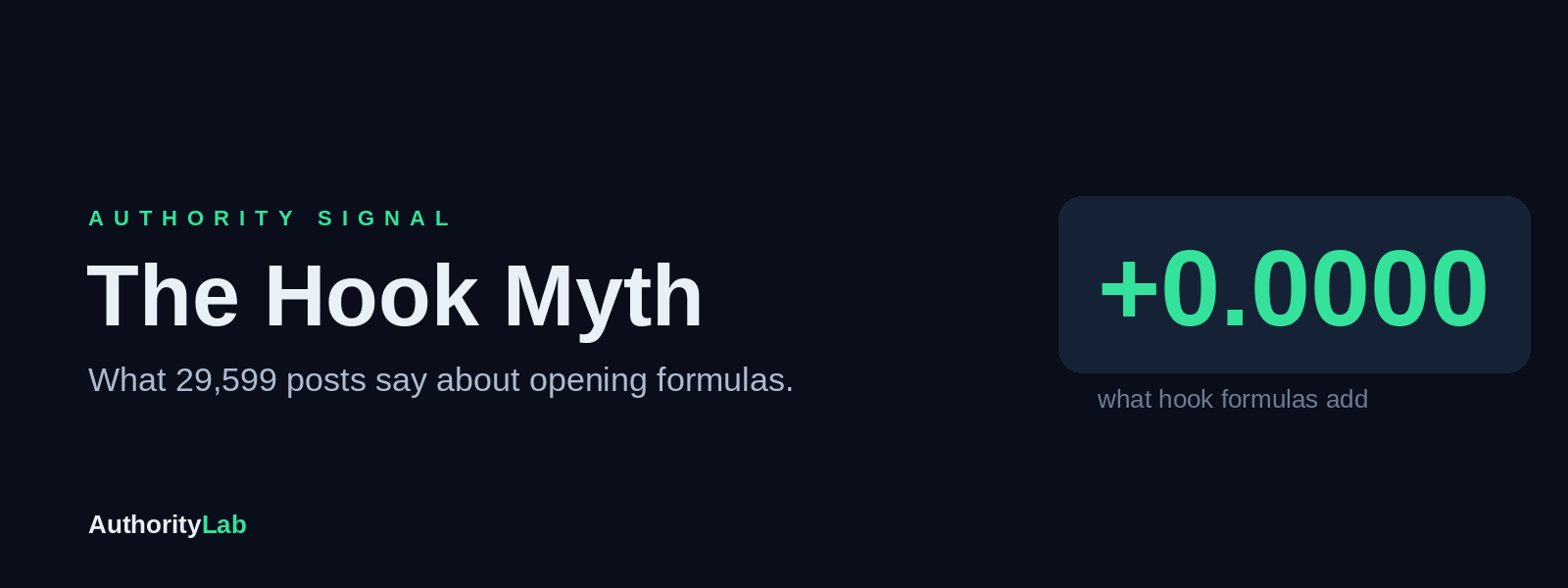
Do LinkedIn Hooks Matter? What 29,599 Posts Say
I once rewrote the first line of a post eleven times.
Eleven. I know it was eleven because I kept them in a list, stacked one under the other, so I could compare them like a man choosing paint. The question version. The number version. The version that opened mid-scene. The one-word version, on its own line, because a course I had paid for said a one-word opener stops the scroll.
Somewhere around the seventh I stopped reading them as sentences and started reading them as shapes. That is the state you get into. You are no longer writing, you are auditioning openings for a jury of one, and you have completely forgotten what is behind the door.
I picked number nine. I published it in the morning. It did nothing.
And the reason it did nothing was sitting there in plain sight, which I could not see at the time because I had spent all my attention on the doorway. The post underneath had no argument. It had a topic and a tone and some tidy formatting, and it wandered towards a conclusion it never quite reached, because I had never decided what I was claiming. Eleven doors on an empty house.
I want to be precise about the failure, because "I wrote a bad post" is not the lesson. The post was competent. Every individual sentence in it would have passed a review. What it lacked was a spine, one sentence somebody could have disagreed with, and the eleven openings were eleven attempts to disguise the absence of one. A good hook on an argument-free post is a well-lit corridor to nowhere. The reader gets further in before they realise, which is arguably worse.
So when we came to fit the model, I made sure the hook features went in as candidates. Partly for completeness. Mostly, if I am honest, because I wanted the years I had spent on first lines to have bought something.
What we measured
Six hook features, measured on every post in the Index: hook length, numbers in the hook, question hooks, first-person openers, contrarian opening language, and pattern interrupts. The whole swipe-file arsenal, quantified across 29,599 posts.
On their own, those six features predict outcomes at an AUC of 0.554, where 0.5 is a coin flip. Weak, but not nothing. Then we added them to a model that already held the seven levers (position, development, closing, intent, funnel, proof and format) and measured how much the prediction improved.
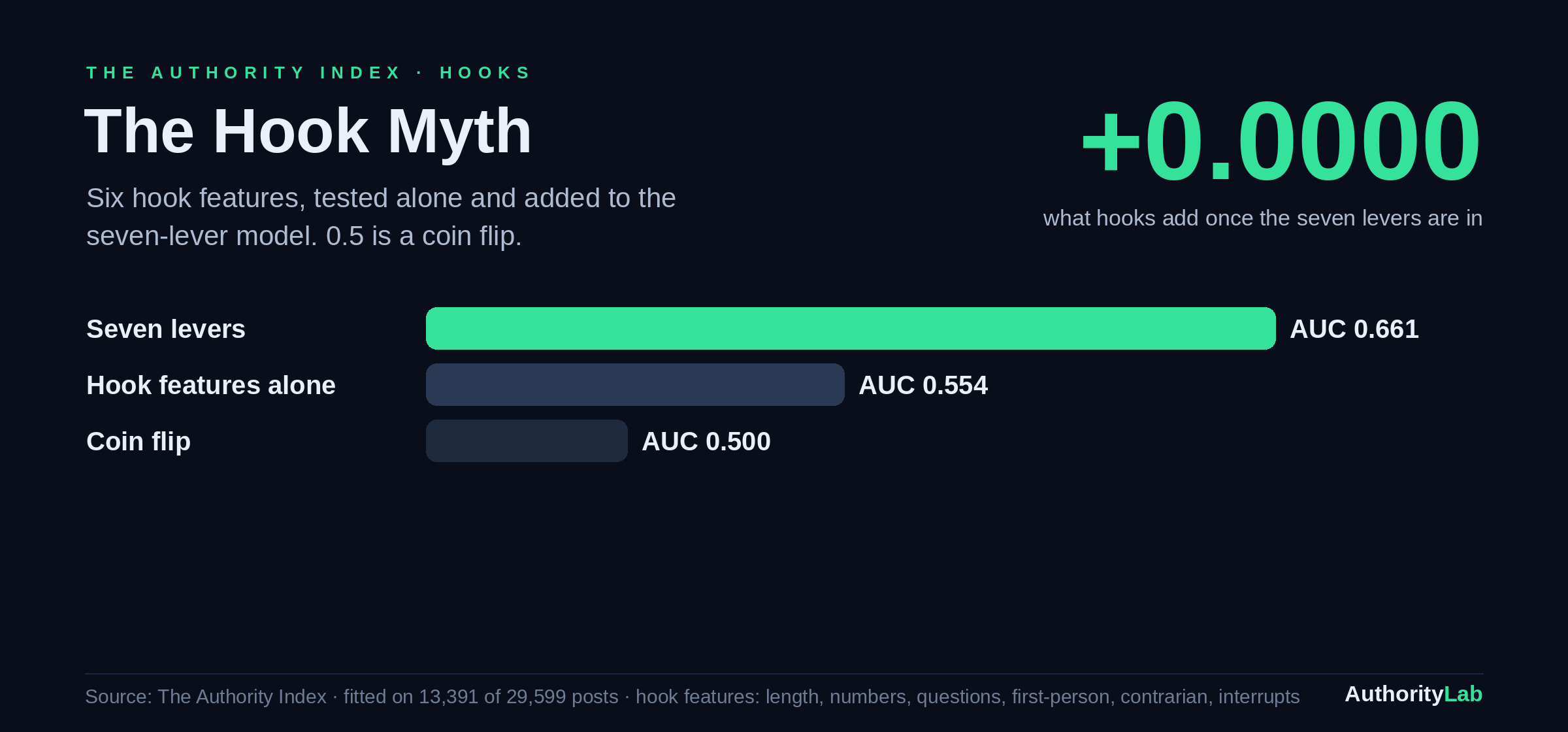
I have run that check more than once, looking for the mistake. There is a particular feeling when a result comes back that clean. You do not celebrate. You go looking for the bug, because a number that tidy is usually a number you have computed wrong. It held.
Why the doors are what gets sold
There is a reason the first line has an entire economy attached to it and the argument underneath does not.
A hook is teachable in an afternoon. You can put twenty of them on a slide, hand them over, and the person walks away holding something they did not have that morning. It is a clean transaction. Whereas "decide what you actually think about your field, and be willing to be wrong about it in public" is not a course. It is a decade, and nobody can sell you the shortcut, because there is not one.
So the industry sells the part it can package. I do not think that is a conspiracy. It is just what happens when demand meets the only thing that can be delivered in a PDF. But it does mean the volume of advice about openings tells you nothing about the value of openings. It tells you about the shape of the market for advice.
What zero means here
It does not mean the first line of your post is irrelevant. The first line still decides whether anybody reads the second, and a post nobody opens earns nothing at all. What it means is narrower, and I think more useful. Whatever a good opening contributes is already carried by the substance underneath it. Posts with a real position tend to open well, because a real claim produces its own first line. The formula was never the active ingredient.
That reading fits the alone-number too. Hook features scrape 0.554 by themselves because they travel with good posts, the way expensive shoes travel with good salaries. Buy the shoes. Watch the salary stay exactly where it was.
The doorknob
The name I now use for this, because I need something short enough to catch myself with, is the doorknob.
Polishing the doorknob is any work you do on the entrance to an argument you have not finished having. It feels like craft. It is measurable, in the sense that you can see the version count going up. It has a comforting stopping condition, because eventually one of the versions sounds punchy and you go with that one. And it is the single easiest way to spend a whole morning on a post without improving it by one point.
Say "hooks are pointless" out loud and you will start an argument, and the argument is fair, because put that flatly it is too strong. Here is the precise version. Hook formulas carry no measurable signal once substance is measured. The first line matters enormously. Those two sentences are both true, and living with both of them is the entire skill.
The version of me who kept eleven openings in a list was not being lazy. That is the annoying part. Eleven rewrites is real effort, applied with care, at the wrong end of the post. It is the most expensive kind of mistake there is, because it feels exactly like the work.
What to do with this
Write the claim first. One sentence, arguable, yours. Nine times out of ten the opening line is already sitting inside it, and you will spend thirty seconds finding it instead of a morning inventing it.
Stop A/B testing opening formulas. The variant was never the thing that moved. If two versions of a post perform differently, look at everything except the first line before you draw a conclusion from it.
And treat a difficult opening as a diagnostic. This is the part that changed how I work. When I cannot find the first line now, I stop trying to find the first line. It is a reliable signal that the idea underneath is not sharp yet, and no amount of polishing at the entrance will fix a room I have not built.
The house first. Then the door. The doorknob, if there is time.
See where you stand. The free Authority Lab audit scores your writing and your profile against the Index and shows you which lever is costing you the most points.
Want it pulled apart with you? Book a 30-minute Authority Consult and we'll run your profile against the data, live.
Every figure here is one cut from the Authority Index: 29,599 classified LinkedIn posts from 53 creators.