
Why the Best LinkedIn Posts Skip the CTA
I have run the lead-magnet close. More than once, and recently enough that I cannot pretend it was a phase.
You know the move because half your feed runs it. Write something useful, stop just before the useful part, then offer the rest as a download. Comment the word and I will send it over. And it works, in the narrow sense that the comment count goes up and your notifications get busy and you spend the evening sending links to strangers, feeling like a person whose content is performing.
What I never asked was what it cost, because the thing it costs does not show up in the notification bell. Nobody comments "I liked you slightly less after that". They just quietly reclassify you, from someone worth reading into someone running a funnel, and you find out about the reclassification six months later when the good readers have gone somewhere else.
I found the receipt for that by accident, and not while looking for it.
The number that would not sit still
I was doing repair work on the classification vocabulary. Dull, necessary plumbing. Somewhere in the middle of it, a figure I had quoted on five separate surfaces came back different: the share of posts in the corpus that end with no call to action at all had been 35.6%, and the cleaned-up count said 34.8%.
Tiny difference. Enormous temptation. The obvious move is to find every instance of the old number and swap in the new one, and the obvious move is wrong, because I could not explain where the first figure had been computed. Two numbers that close together, with no derivation for one of them, is not a rounding problem. It is a claim I had been repeating on trust.
So the old figure came down rather than being patched, and the rule stuck: a claim gets re-derived, never find-and-replaced. And while I was down there re-deriving it, I found the more interesting thing sitting next to it in the model. Endings have prices. Somebody had put them on the board and I had never looked.
Two things were true at once and I had only ever looked at one of them. The close I was running produced the most visible response of any close available to me, and it sat at the bottom of the list of things that predict a post landing well. Visible response and a post working are not the same object. I had been reading the first as evidence of the second for years, because the first one pings your phone.
The fitted price of every ending
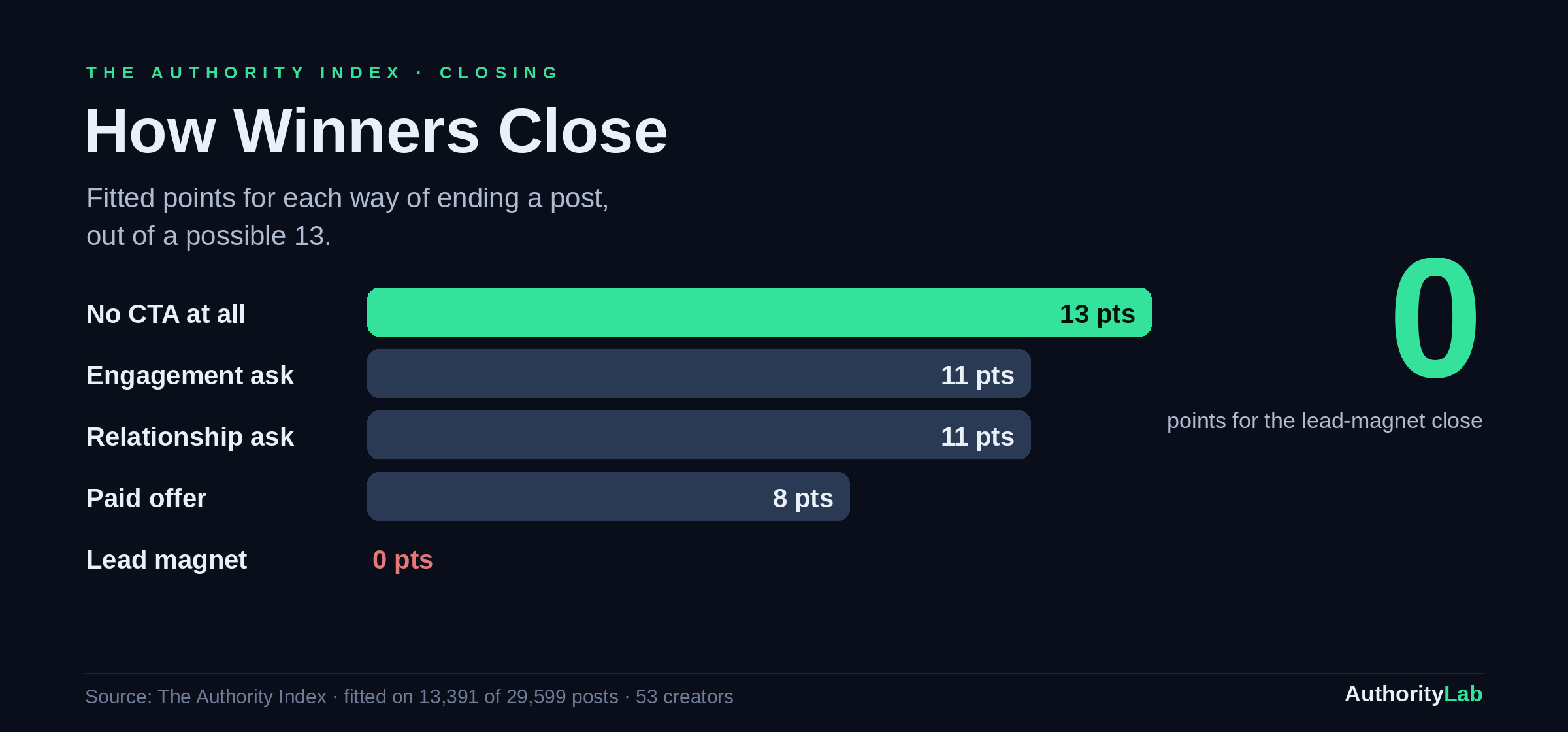
Every post in the Authority Index carries a closing classification: engagement ask, relationship ask, paid offer, lead magnet, or no call to action at all. When we fitted the seven-lever model, closing earned 13 of the 100 points, and the weights inside it tell the story.
No CTA at all scores the full 13 points. An engagement ask ("what do you think?") scores 11. A relationship ask (follow, connect) also 11. A paid offer, 8. And the lead-magnet close, the one I had been running, scores zero. Not a small number. The bottom of the list, by a distance.
The masters already write this way
This is a case where the measurement and the behaviour agree, which does not happen often enough to pass without comment. Roughly a third of the posts in the Index end with no ask of any kind. The exact share moves a little depending on how you count it, which is the whole story of the previous section, but every cut we run lands near a third. Outright hard-sell posts, meanwhile, are rare company: about one post in ten per creator.
The people with the most to sell ask the least, at least in the feed. They are not shy and they are not leaving money on the table. They have simply worked out where the asking belongs, and it is not stapled to the end of every idea they have.
The switch
I can only tell you how the two endings read, because reading is the part the data cannot do.
A post that lands its idea and stops treats the reader as the point of the exercise. A post that lands its idea and then asks for something reframes everything above it as setup. The argument you just made becomes the price of admission to the pitch, retrospectively, in the reader's head. They feel the switch even when they never name it, and the next time your name appears they open the post already braced for it.
That is the whole mechanism as far as I can see it. One ending gives you a reader. The other gives you a lead, once, and charges you the reader for it.
What it cost me to believe this
Our own funnel had a step in it that mapped straight onto the zero.
Six moves, sequenced, sensible, and step six was a soft offer to go and watch a demo. By our own model that close is worth nothing, and I had built it, drawn it on a whiteboard, and shown it to people while explaining that the data decides. The step is now different. The finding stayed exactly as it was.
That order matters more than the fix. It is trivially easy to run an analysis, notice it indicts something you have already built, and discover a methodological reason the analysis does not apply to your case. I have watched other people do it. The only defence I know is publishing the number before you have worked out what it means for you.
The habit I have now is a question rather than a rule, because rules are how I got into this. Before the last line goes on, I ask what this post is for. If it is for selling, it can sell, plainly, without the apologetic wrapper. If it is for building the case that I am worth listening to, then asking for something at the end is charging admission to my own argument, and I have never once been persuaded by someone who did that to me.
What to do with this
End your next five posts on the idea itself. The last line states the point, or the consequence of ignoring it, and then stops. It will feel abrupt for about a week, mostly because you are used to the sound of your own throat clearing.
If you genuinely need engagement, ask something worth answering, the kind of question you would put to a smart colleague, and count it as your 11-point option rather than your default.
And retire the lead-magnet close. The model puts it dead last, your best readers already suspected it, and the download was never the reason they were reading you.
See where you stand. The free Authority Lab audit scores your writing and your profile against the Index and shows you which lever is costing you the most points.
Want it pulled apart with you? Book a 30-minute Authority Consult and we'll run your profile against the data, live.
Every figure here is one cut from the Authority Index: 29,599 classified LinkedIn posts from 53 creators.