
Validate: The Post Intent Almost Nobody Writes
For most of this summer my own editor offered you six kinds of post. Six little buttons along the top: Teach, Inspire, Provoke, Connect, Sell, Entertain. You pick the job your post is doing, and the editor coaches you towards it. I designed those buttons. I wrote the line of copy under each one. I put "six intent types" on our marketing pages and in our lessons, and I said it on calls in the confident voice you use for things you have never checked.
The machine underneath had seven.
It had always had seven. The classifier that reads every post in the Index sorts each one by what it is for, and the seventh answer sat in its list the whole time, like a guest nobody introduced. Validate. The post that tells the reader the thing they suspect is true, and shows them why.
Nobody could pick it. You could write one, and the model would score it. You could not say you meant to. A plan that asked for a Validate post opened the editor with nothing selected, which is the software version of a waiter bringing you an empty plate and a nod. Deeper in, the weekly planner was quietly dropping every Validate draft from the mix. (Nobody complained. Nobody knew it existed. That is the trouble with a missing option: it has no fans.)
I did not find this by being clever. I found it by cleaning up a mess I had made earlier, which is how I find most things.
How I lost an intent inside my own product
The mess was the labels. The old classifier prompt showed the model its choices as one long string joined by pipes: Teach, then a pipe, then Inspire, and so on down the list. The model did what a keen intern does with an example. It copied the shape. It wrote answers like "Teach|Sell", which is less a label than a shrug. By the time I looked, the intent field held 74 different values where there should have been eight: seven intents plus other.
On 12 August I rebuilt the prompt so the model had to pick one answer from one list, and folded every stray label back into that list. Nothing was left unmapped. That afternoon we ran the first live audit on the new stack, one real creator's recent posts, and I read the intent mix line by line. Teach at the top, then Sell, Inspire, Connect, Provoke. And Validate, five times. The first time it had ever been measurable in a report.
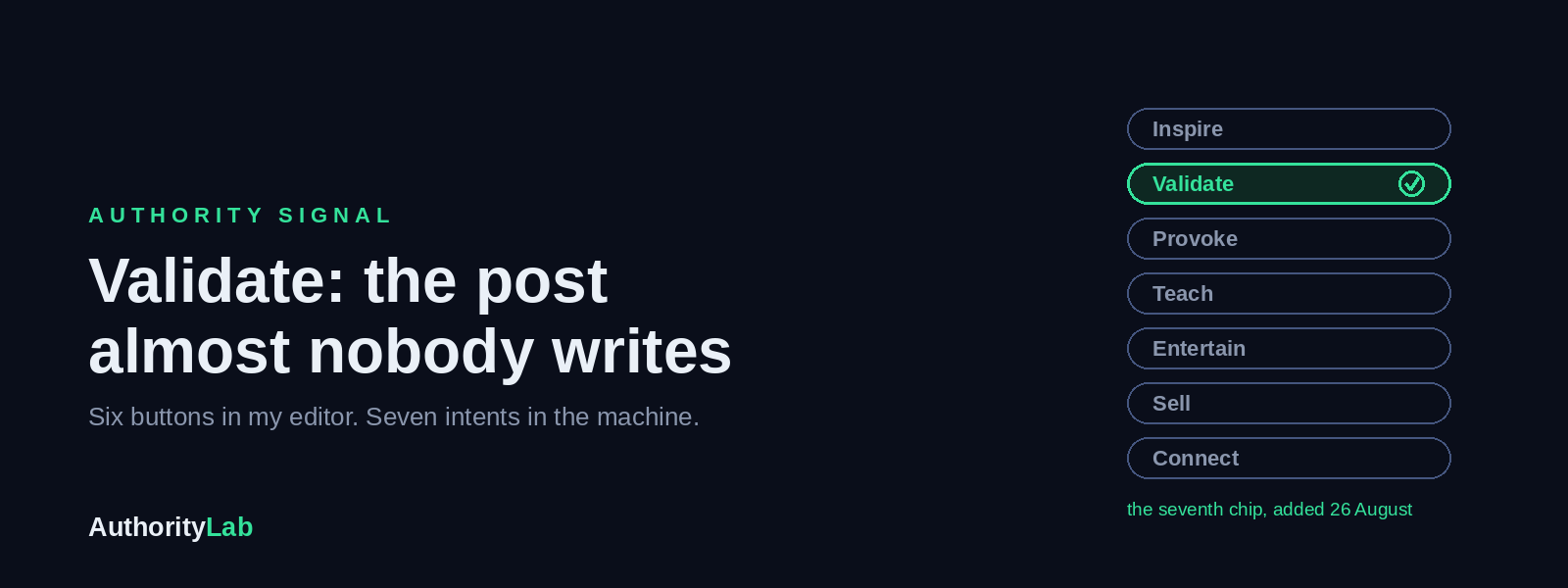
So a working creator had been writing the post my product could not name. Two weeks later, counting the corpus for a different job, I noticed the editor still had six buttons. On 26 August Validate became the seventh chip, with a little tick in a circle for an icon. It still has no colour of its own. It borrows the neutral grey until I choose one, and I have been failing to choose one for over a month. (Me and colour charts is a story for another day.)
What the model thinks it is worth
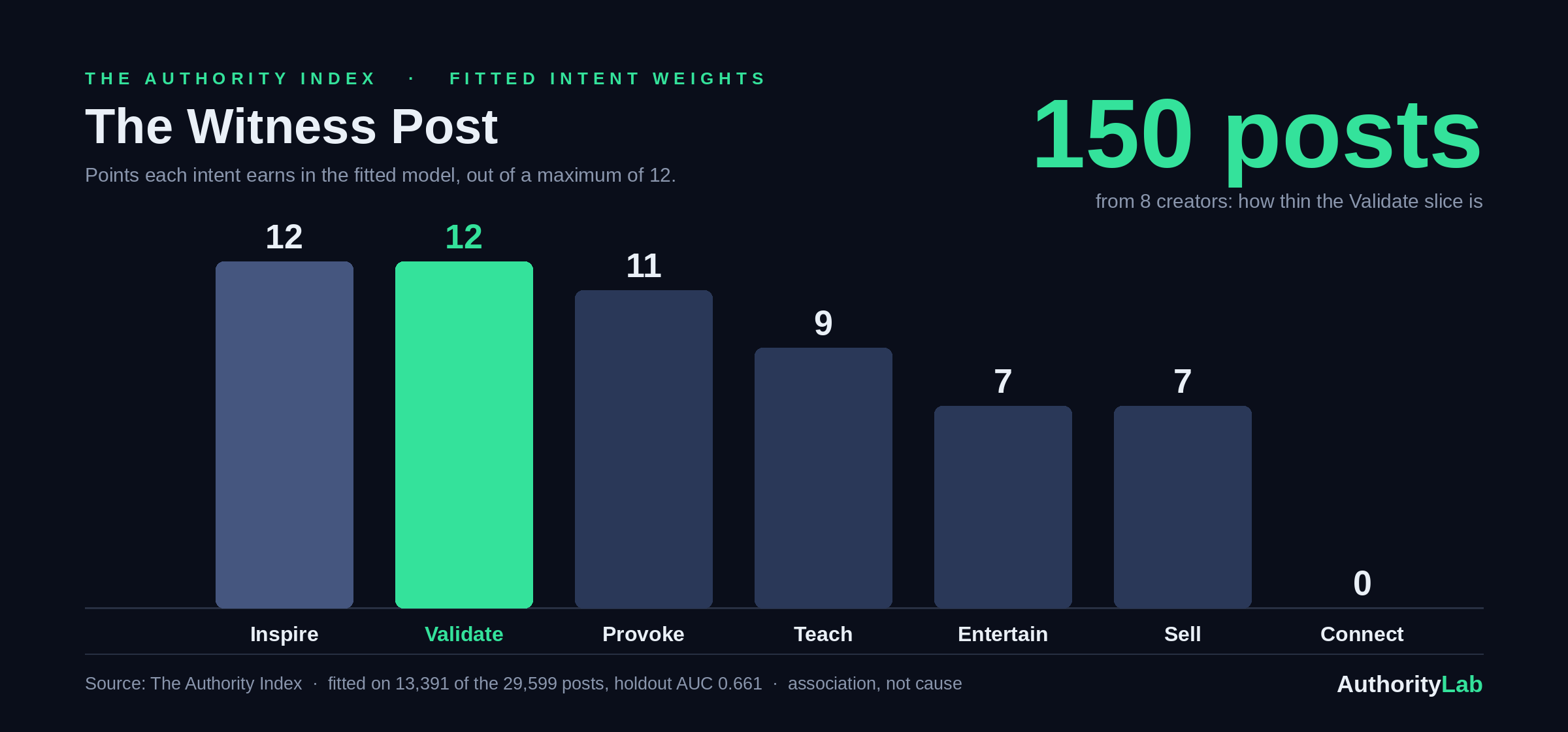
This is the part that made me put my tea down. When we fitted a model to find what predicts how a post lands, intent earned a place among the seven levers. Validate takes the full 12 points that intent can give. So does Inspire. No other intent does. Teach, the job nearly everyone on LinkedIn is doing all day, takes 9.
Read that again with the story in mind. The intent my product hid was tied for the top of the price list. The intent my product quietly nudged people towards sat three points down. I had built a menu that left off the dish the kitchen priced highest.
Now the other number, the one that keeps me honest. Across the whole Index, Validate reports 150 posts, from 8 creators. That is thin. It could be a few people's habit rather than a pattern. The data is almost funny about how clearly it says both things at once: this intent is priced like the best on the platform, and hardly anyone writes it.
The witness post
So what is it, exactly? The definition in my editor is one line: confirm what your reader already suspects, and show them the evidence for it. I call it the witness post, because that is the job. A teacher tells you something you did not know. A witness tells you that the thing you saw was real.
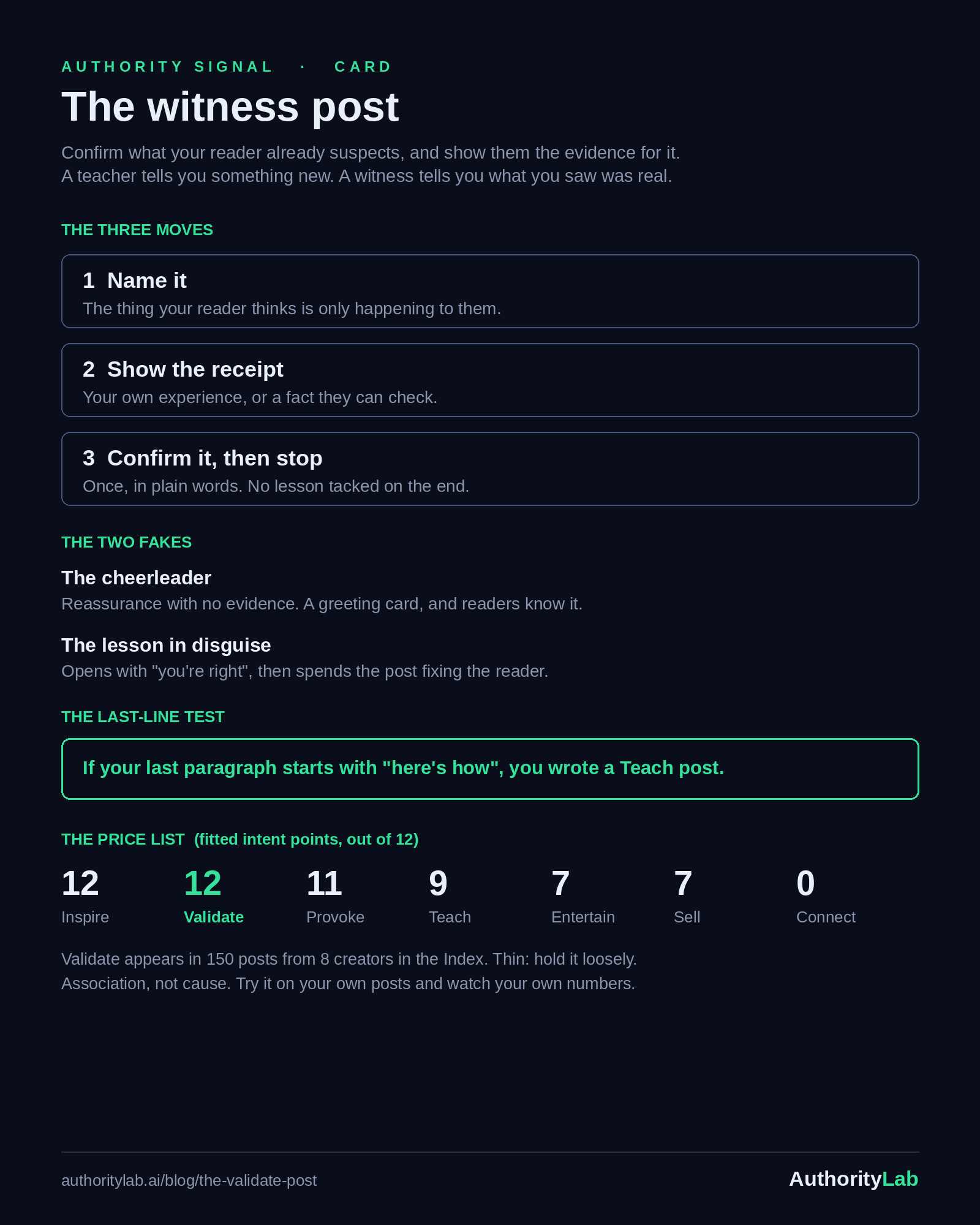
It has three moves, and only three. Name the thing your reader thinks is only happening to them. Show the receipt: your own experience, a measured fact, something they can check. Then confirm it, once, in plain words, and stop.
Two fakes look like it from a distance. The first is the cheerleader. "You've got this!" with no evidence is a greeting card, and readers can smell a greeting card from the next postcode. The second is the lesson in disguise. It opens by telling you that you are right, then spends four paragraphs on how to fix you. That is a Teach post wearing a nice coat. If the last paragraph starts with "here's how", the witness has left the room.
Why is it so rare? My guess, and it is only a guess, is that correction flatters the writer. When I teach, I get to be the one who knows. When I witness, I spend my authority on you, and I get nothing back except your relief. Most of LinkedIn is queuing up to correct you. Very few people are queuing up to tell you that you saw it right.
My first one, and the number I nearly got wrong
Earlier this month I drafted my first witness post on purpose. I was the least natural person to write it. I built a machine whose whole job is to tell people what to fix. My instinct, every time, is the lesson.
The draft opened on the scarcity: my machine had read the Index, and hardly any of it did this one thing. Then I checked the count against our facts file, the one place every number I publish has to come from. My draft's count was one too high. It had come from an older, bigger pile of rows. The post about how rare something is had overcounted it. I fixed it everywhere it appeared, and felt the specific shame of a man who runs a data company and cannot count to a hundred and fifty.
The ending was the part I got right, mostly by accident. The post finished by doing the thing it described. It told anyone posting to a small audience, with no pod, no scheduling trick and no template, that they were doing the hard version. The slow one. That they were doing it right. The form demonstrated itself. For once, the reader left holding something other than homework.
What I do differently now
I check the menu against the machine. The editor, the planner and the classifier now carry the same seven, and the planner can suggest a Validate day, which it could not before. A missing option has no fans, so nobody will ever report it. You have to go looking.
And before I write, I ask one question first. Does this reader need to learn something, or do they need to be told they were right? Most weeks, if I am honest, it is the second, and I reach for the first because it makes me look clever.
Here is the universal version. Most people you write for do not need another lesson. They need a witness.
See where you stand. The free Authority Lab audit scores your writing and your profile against the Index and shows you which lever is costing you the most points.
Want it pulled apart with you? Book a 30-minute Authority Consult and we'll run your profile against the data, live.
Every figure here is one cut from the Authority Index: 29,599 classified LinkedIn posts from 53 creators.