The Seven Levers: What Actually Predicts LinkedIn Engagement
I spent a month teaching a machine to read.
Not to write. To read. Every post that goes into the Index is examined by a classifier that works through the same interrogation every time, on every post, without getting bored. What is this trying to do? Does it take a position, or hover politely near one? What kind of proof does it carry, if any? How does it end? Is there an image, and what sort? How hard is it to follow?
I was proud of how many questions I had managed to ask. That was the mistake.
Because I went into this expecting the answer to be a long tangled list where everything mattered a little. Hooks a bit. Timing a bit. Formatting, emojis, white space, line breaks, the day of the week, all of it contributing a slice, which is roughly what the advice industry sells and roughly what I had been repeating. And privately I expected the biggest slice to go to format. I had been telling people to post images for years. I had a number I liked quoting to prove it.
Then we fitted a model to the classifications and asked which of those fields could actually predict anything, and most of my careful reading turned out to be decoration.
The thirty-point question
The setup, briefly. Every post in the Authority Index is classified across more than a hundred fields. We fitted a scoring model on 13,391 of the 29,599 posts, then tested it on creators it had never seen. Asked to judge posts by a writer it was not trained on, it separates the strong from the weak far better than chance (the technical figure is a holdout AUC of 0.661, where 0.5 is a coin flip). The spread between its worst and best scores is real too: posts in the model's bottom tenth hit big 11.4% of the time, posts in its top tenth 56.8%.
What matters is what survived. Out of all those fields, seven carry the signal. Here they are with their fitted weights, out of 100 points.
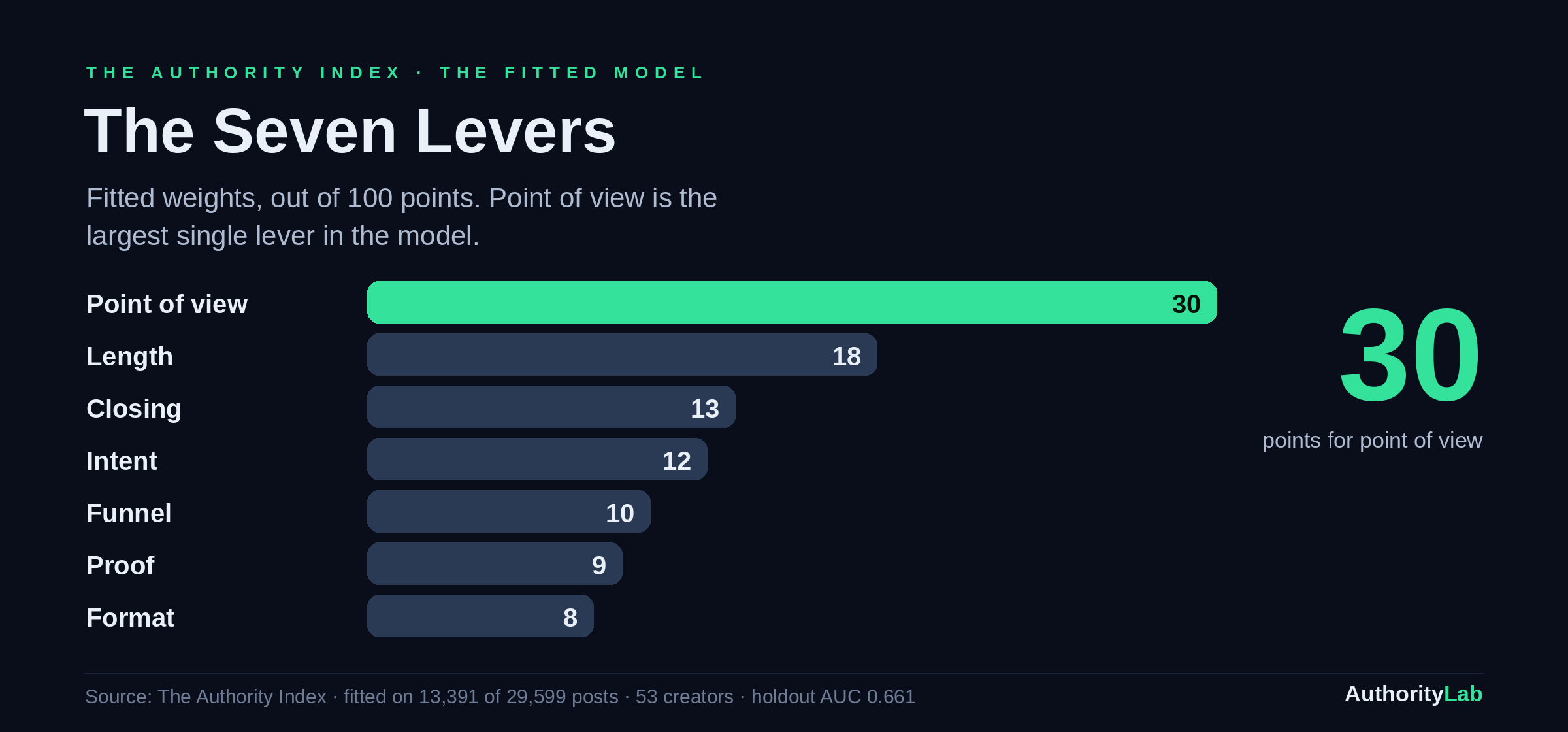
Point of view is worth 30 of the 100. A post with a strong, arguable position takes the full 30. A moderate one takes 10. A post with no discernible position takes nothing at all. That one field is worth almost four times the format field, and nearly as much as closing, intent and proof put together.
The rest, in order: length (18 points, and more on that in a second), how you close (13, where the highest-scoring close is no ask at all), intent (12, with Inspire and Validate joint top), funnel position (10, awareness content at the top and conversion content at zero), proof (9, hard evidence beating soft claims), and format (8, image and carousel over plain text).
So the single most valuable thing you can do to a LinkedIn post is decide what you are claiming. Not describe. Not cover. Claim. That is the thirty-point question, and it is answerable in one sentence or not at all.
The number I had been quoting was wrong
Here is the part I would rather skip.
While the model was being fitted, I was re-running every simpler comparison in the corpus under one new rule: if you group posts by something that correlates with who wrote them, you have to run the comparison inside each creator before you publish it. Otherwise you are not measuring the thing, you are measuring the crowd that happens to do the thing.
Images were the first casualty, and they were my favourite. Pooled across everybody, image posts looked like they earned 3.04 times what text posts earned, and I had said so in rooms. Measured inside each creator, against that same person's own text baseline, the median lands at 1.41 times, true for 42 of the 53 creators. Still a real advantage. Nothing like the one I had been selling. Carousels came out close to a coin flip.
Two of my own published claims went in the bin that week, and the format lever, the one I had been quietly betting on, came back worth 8 points out of 100.
I still catch myself at it. I will open a draft and spend twenty minutes deciding whether it wants an image, get the image right, feel productive, and only then notice that I never decided what the post was for. Twenty minutes on the eight-point lever and none on the thirty-point one. Knowing the weights does not immunise you against this. It only shortens the time it takes to notice.
The uncomfortable version: for years I had been giving people advice weighted almost exactly upside down. The cheap, visible, satisfying stuff at the top. The expensive, invisible, hard stuff at the bottom, if I mentioned it at all. Deciding what you think is hard. Choosing a template is not.
What the model refused to keep
Just as telling is what died in the fitting. Hook length, question hooks, numbers in the hook, first-person openers, contrarian opening lines: none of them made the model. They add exactly zero predictive power once the seven levers are in. That finding is large enough to have its own piece, and it is the single most argued-with thing I have published.
What to do with this
Read your last five posts and ask one question of each: what am I claiming here? If you cannot state the position in a sentence, the post does not have one, and you left the largest lever in the model untouched. It will feel like the post was fine. It probably read fine. It just did not say anything anyone could disagree with, and nothing that cannot be disagreed with is worth agreeing with either.
Then work down the list in order. Is the idea developed all the way, or abandoned halfway with a line break for drama. Does the ending resolve or beg. Is there one hard piece of evidence in there, or only adjectives. Format comes last, because it is worth the least, and it is the one you were going to do first.
The caveat
A model fitted on top-tier creators describes what separates strong posts from weak ones inside that company. It is a map of association, and I will not dress it up as cause. Creators with something to say may simply be better at everything, position included, and no amount of arguing at a spreadsheet can rule that out.
But when one field is worth 30 points and another is worth 8, spending your effort in proportion is the rational bet. I now write the claim before I write the post. If the claim will not hold still long enough to be written down, the post is not ready, and no opening line is going to rescue it.
See where you stand. The free Authority Lab audit scores your writing and your profile against the Index and shows you which lever is costing you the most points.
Want it pulled apart with you? Book a 30-minute Authority Consult and we'll run your profile against the data, live.
Every figure here is one cut from the Authority Index: 29,599 classified LinkedIn posts from 53 creators.