
What Top LinkedIn Creators Do Between Posts
In the middle of August I was waiting on a table of numbers, and I already knew what it would say. The best LinkedIn creators, I was sure, live in other people's comment sections. Every guru says so. Comment before you post. Comment after you post. Comment on the big accounts until your thumbs hurt. I had spent weeks building the machinery to capture exactly that behaviour, and I expected the table to be the receipts. In my head the headline was already written: top creators are the most generous commenters on the platform.
The table landed on 14 August. I typed the real headline into my log that same afternoon, and it looked nothing like mine. The median top creator makes short, rare comments on other people's posts, and spends most of their comment activity replying inside their own threads. The gospel had left out the front porch.
That would have been a tidy lesson if I had only been watching. I was practising the gospel myself. Every morning a batch of comment drafts lands in front of me, written to go under other people's posts, because I believed that is what good creators do. So I did what I do when the data disagrees with the crowd. I added a control group of people who preach commenting for a living, to check whether the sermon pays off for the congregation. (That result is a story for another day.) Then I went back to the table and read it slowly, the way you read a bill.
The preaching gap
Here is the idea, named properly. There is a gap between what gets preached about top creators and what the typical one does, and the gap is where the opportunity sits. I call it the preaching gap.
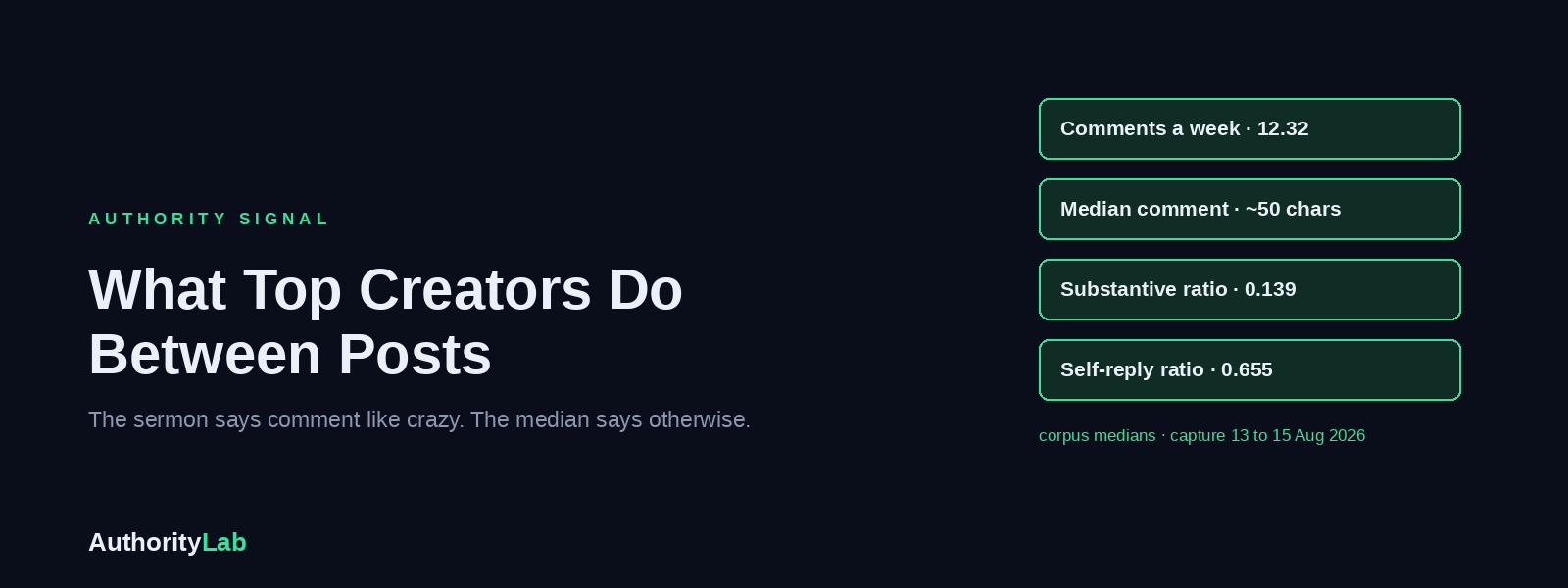
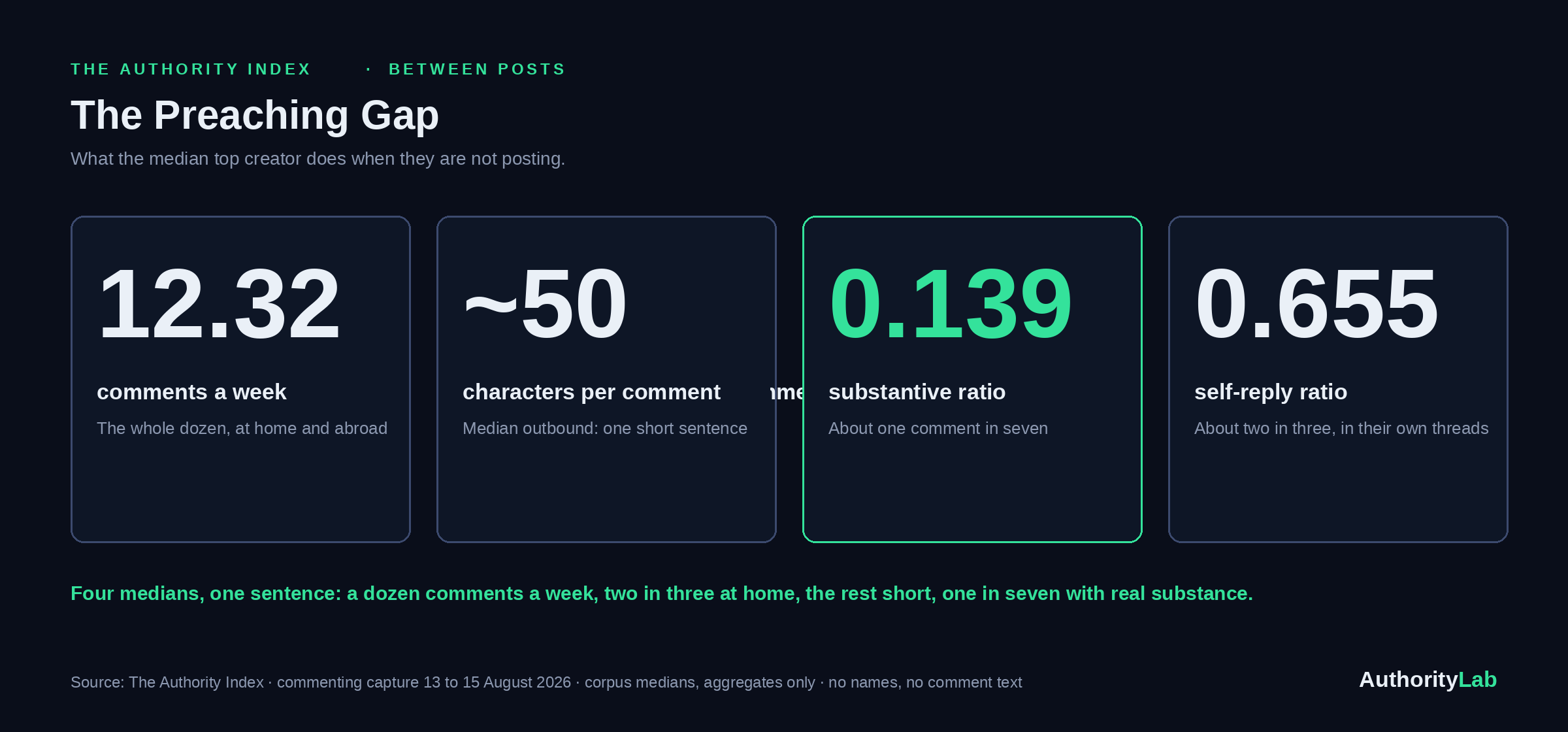
The Index captured its creators' commenting in one pass, from 13 to 15 August. These are the corpus medians. A creator makes 12.32 comments a week. The median outbound comment runs to about 50 characters, which is one short sentence and no more. The substantive ratio, the share of comments with real content in them, comes out at 0.139, roughly one in seven. And the self-reply ratio sits at 0.655, which means about two in every three comments are replies inside the creator's own threads.
Read those four figures as one sentence and they say something plain. About a dozen comments a week. Two in three of them at home. The ones sent out into the world are short, and only about one in seven carries real substance. The typical creator in that pile is not roaming other people's comment sections. They are busy at their own front door.
The front porch
The self-reply figure is the one I keep turning over. About two in three comments are the creator answering people who turned up at their post. Whatever else that is, it is between-posts work, and it happens at home. Somebody commented, and the author showed up. That is a different habit from the one the gurus sell. Theirs is easy to sell: go and find strangers. The version in the data is less glamorous: answer the people who already came.
I cannot tell you from one table that the second habit causes anything. I can tell you it is what the typical creator in the corpus does, and that almost nobody sells it, because there is no hack in it. It is just manners. My own routine pointed the other way, a batch aimed outward every morning, and that is why the table landed the way it did.
A thin crowd is good news
Start with what the substantive ratio means. If about one comment in seven from strong creators carries real content, then substance is scarce even among people who are good at this. That makes standing out cheap. You do not have to out-comment anyone. You have to be the one comment in seven that says something.
The comment study I published in August gives that reading some support. It found that practitioners of the craft sit between 125 and 154 characters, one developed paragraph, and that the post you comment under matters more than any word you pick for it. Set that beside the 50-character median and you can see the distance. The typical comment in the corpus is less than half the length of the shape the study found. Those are two separate questions, what creators do and what lands, and the data answers each on its own. I will not pretend the first one proves the second.
The morning I rewrote the whole batch
Which brings me back to my daily batch. On 26 August I rewrote every comment in it. The drafts were tidy, and tidy was the problem. They had balanced sentences, abstract nouns doing the heavy lifting, and every line weighted exactly like its neighbour. One of them said "Generation stopped being the constraint, review became the queue." It sounds clever. It also sounds like nobody, which is a poor thing to sound like in a comment section.
I rewrote the lot the way a person types a reply on a phone. Lead with a challenge instead of a nod. Concede briefly, and only if it is true. Use a picture you can see: "moved the pile to my desk" beats "synthesise" every time. Open with something like "Half agree." and then say which half. None of that is clever. It is what a person with an opinion sounds like.
Here is the part that stung. The August study says the craft features that survive are small but real: development across a few sentences, a first-person stake, one specific number. My first batch had the polish and none of the stake. It looked like effort and cost me nothing, which is the exact profile of the comment the feed ignores.
What I do differently now
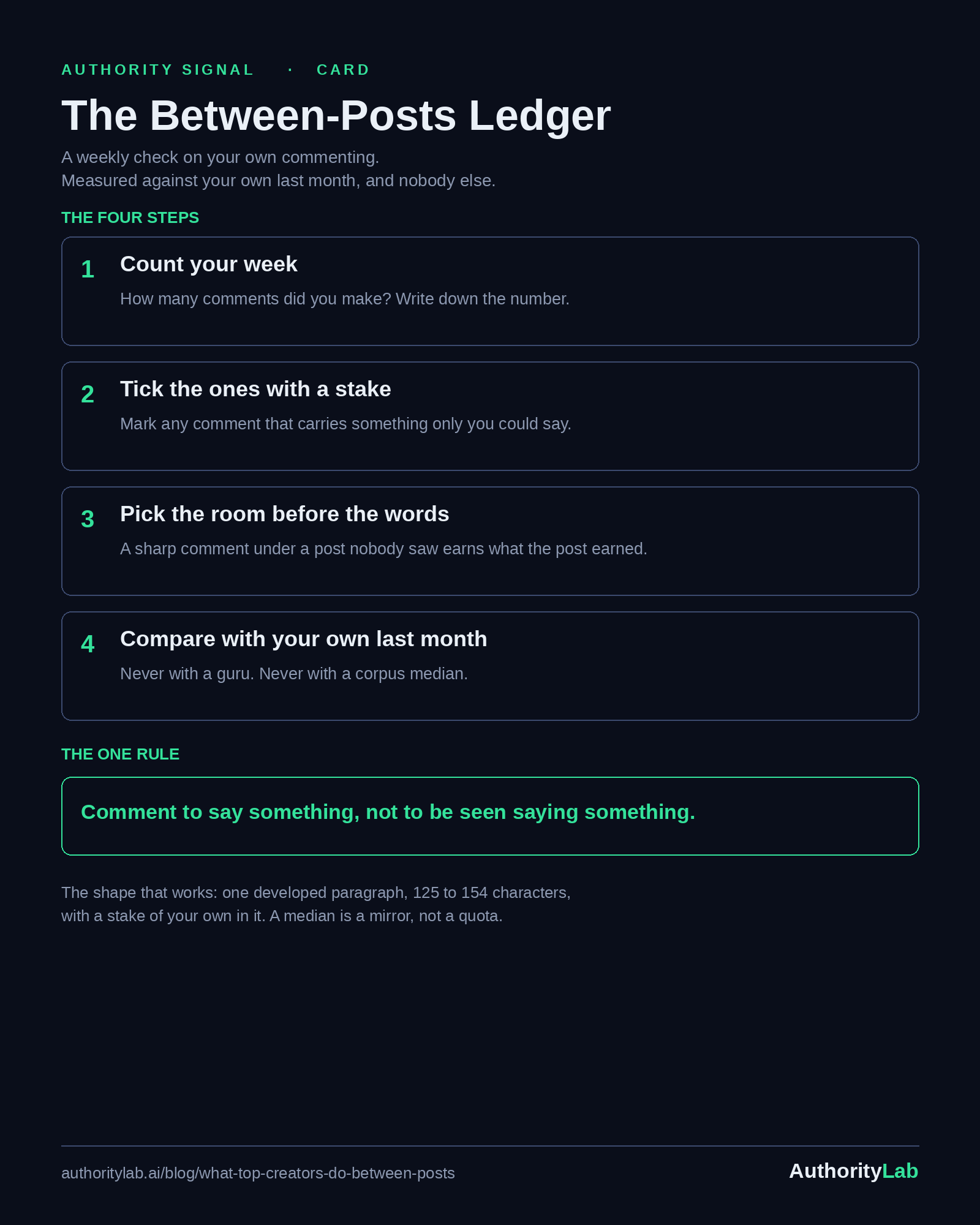
The batch is written in the new register, and I judge each draft by one question: does it carry something only I could say? If the answer is no, it goes in the bin, however polished it is. I also stopped treating the corpus figures as a quota. 12.32 describes the middle of a group of people who are already good at this. It tells me what the pile looks like. It does not tell me what number to hit, and I will not give you one.
Here is the version that travels. Before you copy what top creators do between posts, check what they actually do, because the sermon and the behaviour are not the same document. Then comment to say something, not to be seen saying something.
See where you stand. The free Authority Lab audit scores your writing and your profile against the Index and shows you which lever is costing you the most points.
Want it pulled apart with you? Book a 30-minute Authority Consult and we'll run your profile against the data, live.
Commenting medians come from the Authority Index capture of 13 to 15 August 2026, aggregates only. The wider corpus is 29,599 classified LinkedIn posts from 53 creators.