
Why I Froze the Corpus
In the middle of August I had what felt like a genuinely good idea. My tracker was about to let a customer watch five, ten, fifteen people they think of as peers or rivals, the way you might keep half an eye on the competition without admitting that is what you are doing. My thought was simple: every person a customer added should also grow our own database. More tracked people, more posts, a bigger index, for nothing. I called it the flywheel, because a name like that makes an idea sound like it already works before anyone has built it. I proposed it in a document, approved it a few hours later, and moved on to the next thing, which is one of the small dangers of running a company by yourself. Nobody in the building was going to stop me.
The trouble was already sitting on my own site, waiting to be noticed by someone who was not busy admiring his own flywheel. Two counts live there, a few clicks apart. One says the index holds 29,599 posts. Another says it holds 30,388. Both are true. They measure two different things, and for about a week I had been treating the gap between them as an embarrassing rounding error rather than what it actually was: a warning about what happens to any number once the pile underneath it stops holding still.
The two counts that never agree
29,599 is the analysis cohort, the fixed pile every published claim on this site is measured against. 30,388 is the live label, how big the index looks today, because collection itself never actually stopped. My own rule, written into the code by an earlier version of me, says never to reconcile the two by find and replace, because the claim dies with its number the moment the pile moves. I had read that rule a dozen times and still managed to propose a feature that would have quietly folded a customer's tracked rivals into the very pile the 29,599 comes from. Elsewhere on the site a figure that once meant roughly a third of posts already comes back as three different numbers depending which day you ask it, for exactly the same reason. A pile that keeps moving cannot be a fair test twice, however carefully you word the caption underneath it.
The frozen ruler
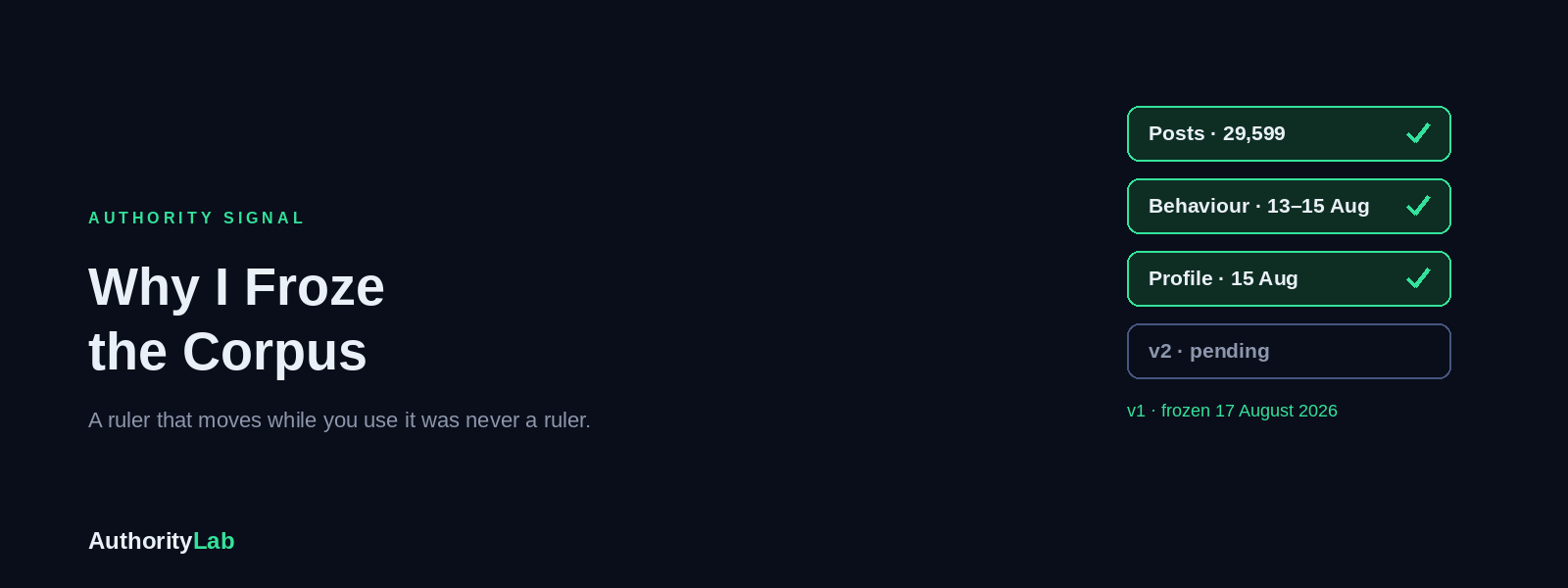
Here is the idea, named properly this time. A measuring instrument only works if it holds still while you use it. You do not re-mark a ruler halfway through measuring a shelf, however much the shelf might deserve it. So the index is now a frozen ruler: version one, dated, and it will not move again until I choose to publish version two. Posts frozen at 29,599, across 53 creators. Behaviour frozen at the comment capture taken over three days in the middle of August. Profile frozen at a capture taken that same week. All three pillars, locked to the same date, so a report scored against version one next year is still being scored against the thing it was scored against today, not against whatever the pile happened to look like by then.
Collection itself does not stop, and it cannot. The comment data behind the index has a hundred and twenty day window on it, so a month I fail to capture is gone for good, not merely late, the way a missed train is worse than a slow one. What stops is the benchmark: the cached number a report actually reads when it scores you. New data lands in a separate pool set aside for the next edition and never quietly touches this one's figures.
Five gates and a cap
Version two will not be everybody who wants in, and it will certainly not be everybody I like. A candidate has to clear five gates: a genuine public professional presence above a follower floor, enough posts and comments to be measurable at all, performance in the top quarter of their own follower band, a real gap the current index does not already cover, and a basic hygiene check against the kind of account that would skew the whole thing on its own if I let it. Clearing all five earns a place on a shortlist, not a seat.
The whole edition is capped at a quarter of the current index, rounded down, with a hard ceiling of 25 seats whatever the percentage says once the index grows large enough for the two to disagree. That puts version two at 13 new creators. I keep the final say over who fills them, veto and all, but the gates decide who is even in the running before I get a vote.
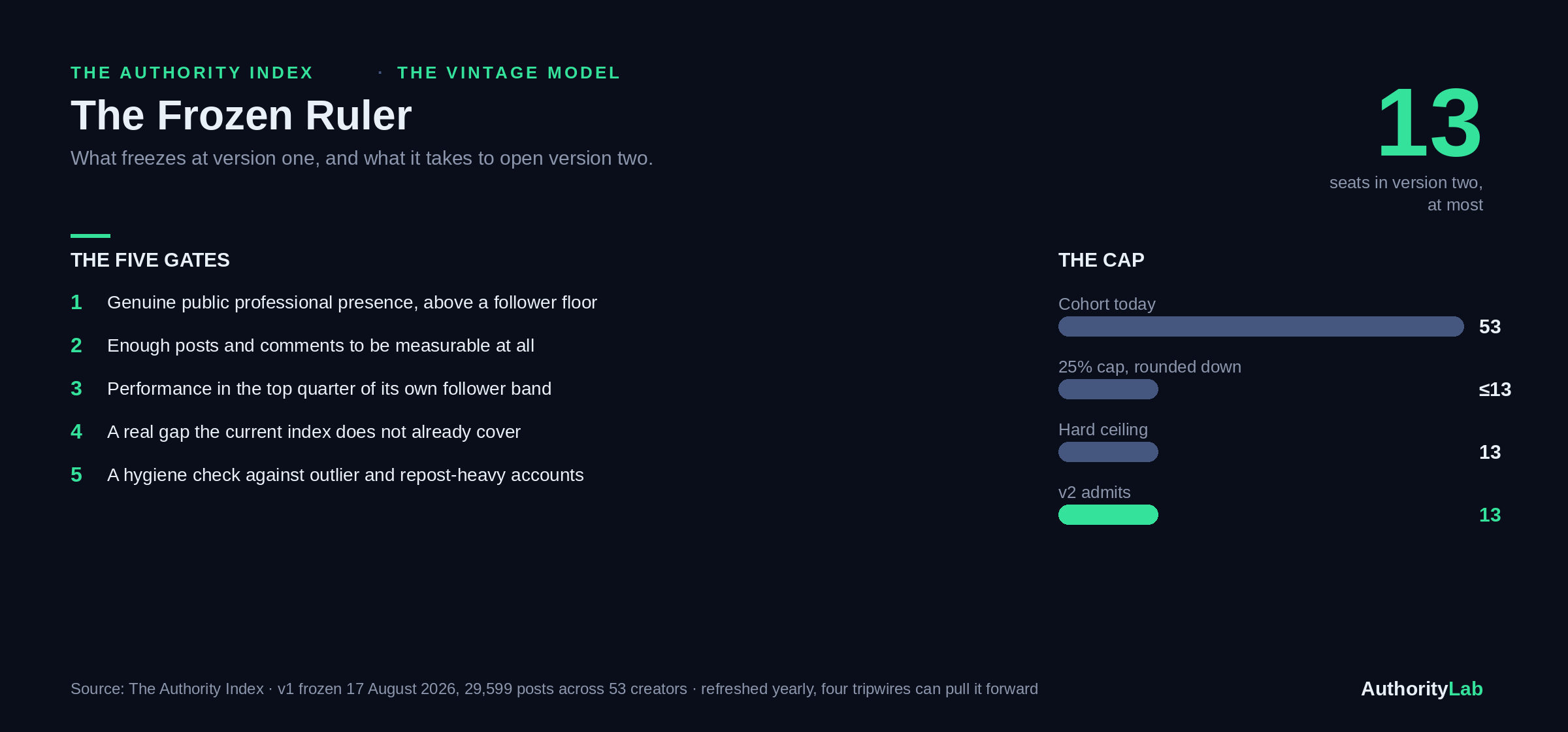
I refresh the whole thing once a year, on a calendar, not on a whim. Four things can pull that date forward: the people already inside show real drift, enough new posts exist to support a fair new count, LinkedIn itself changes in a way that breaks a metric outright, or the vintage simply turns twelve months old and earns a refresh on age alone. I looked hard at doing it every three months, because quarterly sounds thorough, and talked myself out of it. A measuring stick that moves every quarter has stopped being a measuring stick and started being a mood.
The bar I agreed to raise against myself
This is the part I nearly talked myself out of, more than once. If only strong performers get to join version two, the index's own middle ground climbs a little with every edition. Somebody using Authority Lab honestly, genuinely writing better than they did last year, can still watch their own percentile fall, because the bar rose faster than they did. There were two honest ways through that. Quietly widen the entry criteria so the spread stays representative and the ratchet never bites. Or say the true thing out loud, in public, and mean it.
I chose the true thing. My own words on it, from the afternoon I decided: the idea is to copy what the masters do, and I am fine with that. The index does not benchmark the average LinkedIn post. It benchmarks people who are already good at this, on purpose, and the bar is supposed to get harder to clear as they get better at clearing it. The price of saying that honestly is that every edition now needs a second score sitting beside the first, so nobody reads a falling percentile as proof they got worse when the truth is that the room got tougher around them.
What I do differently now
Every figure I publish now carries its vintage, even when saying so out loud is inconvenient for whatever I am trying to argue that week. When somebody asks whether they have improved since last quarter, my first question is which edition their old number came from, because "ahead of most of the index" means nothing if the index underneath it has already changed shape. I would rather tell a customer their comparison is not valid yet than hand them a number that looks precise and measures nothing at all.
Here is the version that travels outside my own product. Before you compare yourself against anything, past self included, pick one date, write down what you are measuring against, and refuse to move it while you are still using it. A target that shifts under you flatters nobody honestly, least of all you, and it will keep doing it for free for as long as you let it.

See where you stand. The free Authority Lab audit scores your writing and your profile against the Index and shows you which lever is costing you the most points.
Want it pulled apart with you? Book a 30-minute Authority Consult and we'll run your profile against the data, live.
Every figure here is one cut from the Authority Index: 29,599 classified LinkedIn posts from 53 creators.